
Aquorbium
Five sound organisms live in a sphere of water. They see and hear each other through the water, hunt, flee, court, defend territory, are born and die, and sing. You do not play notes: you play the environment, and listen to what the life inside makes of it.
Who lives there
MORPH
Nature. The hunter. Predator and territorial, in the foreground.
Sound. An oscillator that transforms: its waveform glides between timbres, from smooth to bright.
In the music. It chases the prey it can see through the water and imitates it in canon, with the delay of the sound's travel; its echolocation clicks speed up into the terminal buzz of the capture.
Explore. Raise DANGER and follow the coral lines of the hunt. Give it the voice body and turn ECOLOGICAL TIMBRE up: its voice sharpens as it hunts.
GRAIN
Nature. The reef of particles. Territorial, in support.
Sound. A granular Striker: impacts made of grains, from brief dust to resonant metal.
In the music. It defends its place and gives the biome texture and pulse, beneath the foreground voices.
Explore. In the SYNTHESIS card, raise STRIKER and move MATTER and SCATTER while the biome plays; try the drop and matter bodies.
MODAL
Nature. The traveller. Migrant, in support.
Sound. A resonator of modes: struck wood, metal and glass, ringing like bowls and bells.
In the music. It makes a wide round of the sphere, about a minute and a half long, and changes perspective: near the glass it sounds clear, far away darker, because the water absorbs the highs.
Explore. Follow it with the LENS through its whole round. Give it the glass or membrane body.
PULSAR
Nature. The prey. In the foreground.
Sound. Pulsar synthesis (Curtis Roads): trains of tiny grains of sound, each with its own formant.
In the music. It flees the predator in diminution - its notes shorten -, or falls silent so as not to be heard.
Explore. Follow the amber lines of flight. In the synthesis device, route prey to the LFO 2 rate: when the reef fills with prey, its pulsing grows nervous.
STRING
Nature. The anchor. Sessile and territorial, in support.
Sound. A physical string: plucked at every note, or bowed.
In the music. It stays near its anchor point and always returns to it; it defends its territory and holds the harmony from below.
Explore. Give it the bow body and raise SUPPORT to bring it to the foreground.
Each one sees and hears only what the water lets through. The lines between them are their relations: coral is a hunt, amber a flight, cyan a school, pink a courtship.
The seed of this visit
Every time the Aquorbium opens, a seed draws a world and a biome. This page does the same, here in your browser, at every visit: it illustrates the idea, it is not the app's sound.
The music is born from the relations
Hunt and flight
A hunter imitates what it heard of its prey, in a canon whose delay is the sound's travel through the water; its echolocation clicks speed up into the terminal buzz. The prey flees in diminution, or falls silent.
Rivals and allies
Rivals answer each other in hocket; allies sing together; a courting pair copies each other's song. Songs pass from organism to organism, like the songs of whales.
Harmony and form
The session has a harmonic language — functional, modal, Brazilian, impressionist, chromatic —, modulates, sometimes lets the high voices wander into another key, and follows an arc of tension to its climax and its rest.
Question and answer
The melody breathes after the cadences; another voice answers with its motif transformed — imitated, inverted, backwards —, and the motif returns later.
The water is the form
- ICE
- COLD
- TEMPERATE
- TURBULENT
- BOILING
The water has five states, and each is a way of playing: ice is a crystal of pitches, dry; cold water is viscous and legato; temperate water is laminar; turbulence brings rubato and heterophony; boiling brings bubbles that ring at their own physical pitch. The sea absorbs the highs with distance; fresh water stays clear.
How you play it
The environment
Density, drift, cohesion, danger, the water and memory change tendencies; the events come from the ecosystem.
VARY
The controls move by themselves over the music's time, around where the seed or your hand left them — warmer at the climax, settling at rest.
The synthesis voice
Each organism has a synthesiser you build; in a matrix, the biome's life — hunger, tension, distance, the water's temperature — plays the parameters.
The lens and headphones
The lens brings your listening close to a region of the sphere; with headphones, each organism comes from its own direction, around your head.
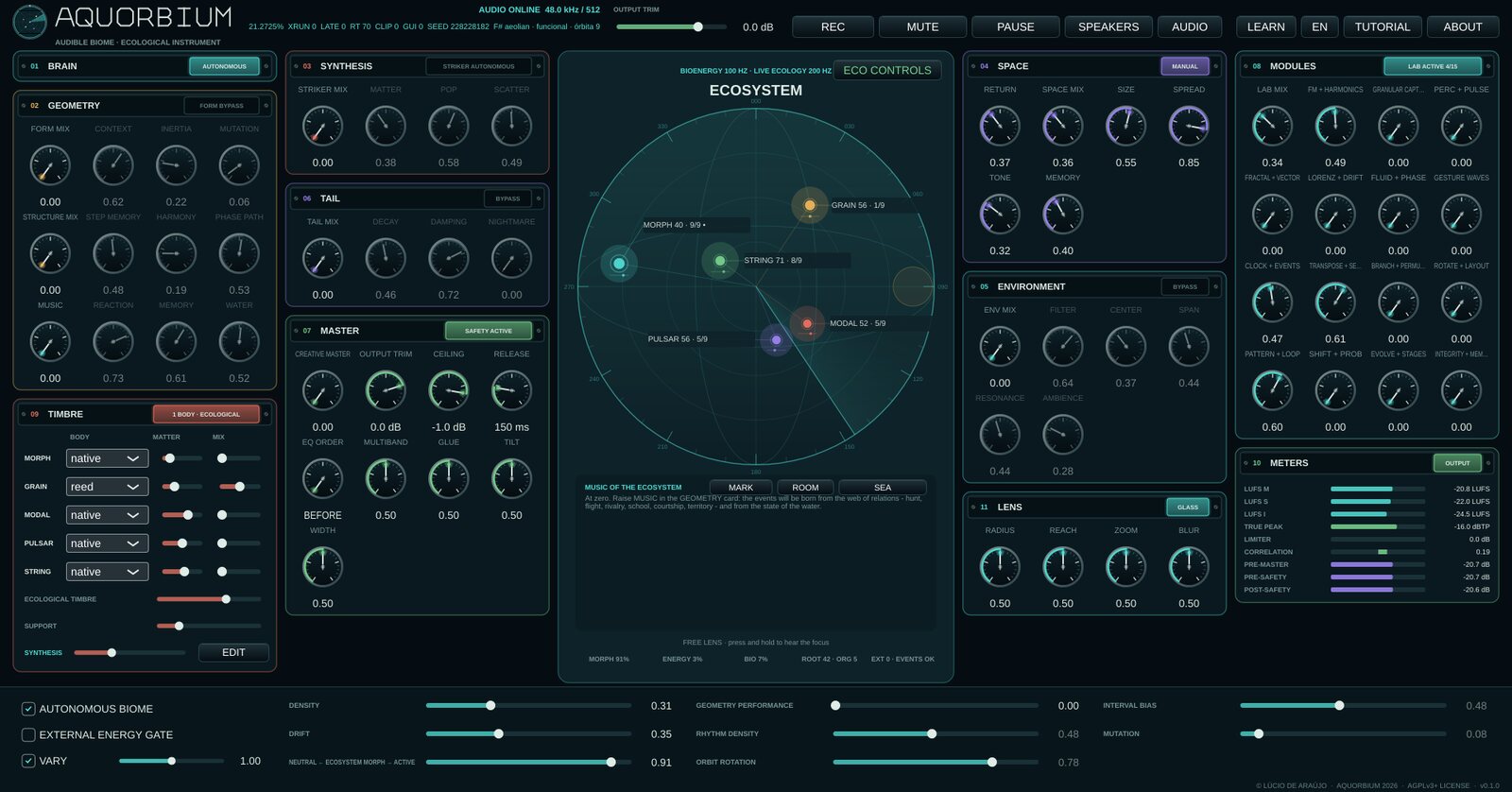
The interface
Download
Choose the package for your system.
Windows
Windows 10 or 11 — installer (.exe) or no install (.zip)
macOS
macOS 10.15 or later, Intel and Apple Silicon
Linux
.deb for Ubuntu, Debian and Mint; AppImage or .tar.gz for other distributions
On first launch, Windows and macOS show a security warning: it is expected, because the app does not carry the two companies' paid signature. The installation guide says where to click.
Credits and sources
Lúcio de Araújo — concept, composition, listening and code. The concepts come from ecoacoustics and bioacoustics (Krause, Schafer, the studies of whale and dolphin song), the physics of sound in water and music theory; no code, sound or text of these works was copied. Licence GNU AGPLv3 or later; JUCE under AGPLv3. Full sources and credits: CREDITS_AND_SOURCES.md.
Status
Version 0.2.2 is the current one; the first public version was 0.1.0, in October 2026. The Windows and macOS packages are built and tested by continuous integration; the instrument is still in development, open.