Rasgo Synth Asterismus
Asterismus is a live instrument in which every synthesis module is a star. The stars relate to each other, move by physics, count their own cycles and play. A seed proposes the sky; the musician plays it, swaps stars, draws relations and records the piece.
The interface
The sky
Stars and seed
36 tone, texture, voice and pulse stars, four of them control stars that do not sound but filter how the others play. The seed chooses eight among the 28 of its draw, a key and a mode, a form and the cycles: every seed is another piece; the other eight come in through the LIBRARY.
The web
Each bar the sky chooses pairs in focus and what each pair does: answer, contagion, shadow, hocket, pedal, friction, cadence. The piece goes through opening, development, contrast and return, and ends with a coda.
Time that breathes
An elastic tempo, a swing that comes from an orbit, bars grouped as 3+3+2, a star that drifts against the pulse, eclipses brought by computed moons.
Physical motion
Gravity, springs, pendulums, billiards, magnetism, spin and foam. Strong collisions sound, and each star sounds in the stereo field where it is in the Constellation.
Cuts and tape
In some parts the sky cuts — parenthesis, montage cut, apocryphal, decimation — and wears: tape or vinyl, tape stop, spin back, varispeed, as the seed chooses.
Playing
The Constellation
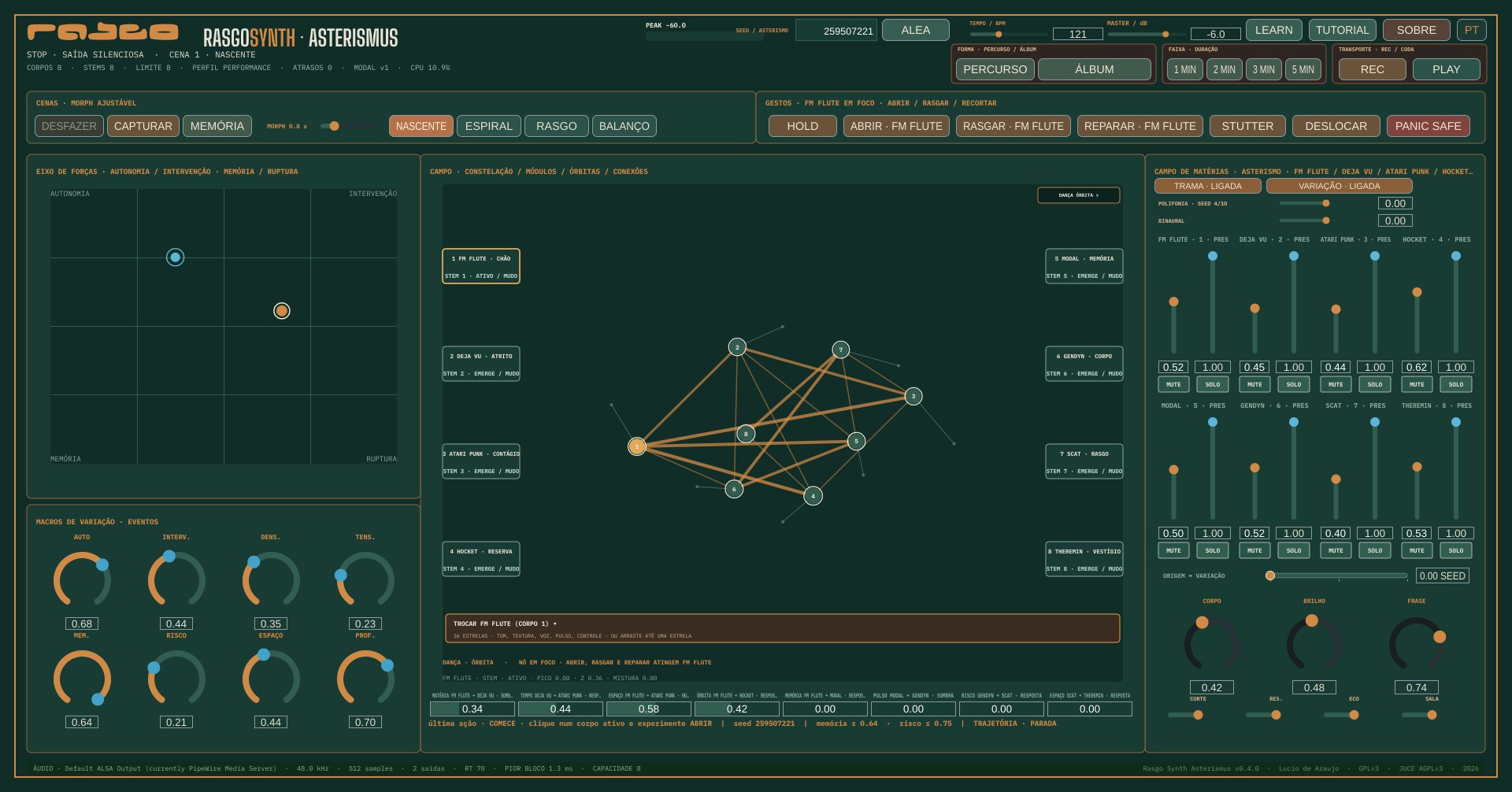
Click a star to put it in focus and drag it to move its place; click a cable to choose its phenomenon and drag it to set its strength.
Gestures and scenes
OPEN, TEAR, REPAIR, STUTTER, DISPLACE, HOLD and PANIC SAFE act on the star in focus. Four scenes and the PATH follow the form.
The mixer and the library
One stem per star, with presence, level, mute and solo, a filter and echo and hall sends; VARIATION lets the sky light and dim stars and POLYPHONY sets how many sound together. The LIBRARY swaps or pins a body's star and opens LEARN, the fiche of each star.
The Axis of Forces
Two points move eight macros — autonomy, intervention, density, tension, memory, risk, space, depth. With the web on, a ring shows the energy and the tension of the sky.
Recording and keeping
- REC records the take: a 24-bit stereo WAV, one WAV per body and a JSON manifest, in one folder per take;
- TRACK · DURATION records a piece of 1, 2, 3 or 5 minutes: the sky's form fits the length and the coda arrives at the end;
- ▶ LISTEN opens the last take in the system player;
- MEMORY keeps eight named places; SAVE SESSION and OPEN SESSION write and read .asterismus files — parameters only, never audio.
Output in the common RASGO standard: fixed gain, limiter with 4× true-peak detection, −1.41 dBTP ceiling, BS.1770 metering and dither on recording. If the sound system stalls or the device disappears, the app reopens it and the piece goes on from where it was.
The app's GUIDE explains everything step by step, and LEARN presents each star — in English, Portuguese, French or Spanish.
Download
Version 0.5.2 brings the binaural shadow (a sky layer for headphones, with a level slider), the TUTORIAL and ABOUT as easier-to-read cards, its own logo and icon, and no more tooltip pop-ups (what changed is in the CHANGELOG). The instrument remains open, in development. Choose the package for your system; the steps are in INSTALL.
Windows
Windows 10 or 11, 64-bit — installer (.exe)
macOS
macOS 10.15 or later, Intel and Apple Silicon
Linux
.deb for Ubuntu and Debian; .tar.gz for other distributions
On first launch, Windows and macOS show a security warning: it is expected, because the app does not carry the two companies' paid signature. The installation guide says where to click.
Sibling of Rasgo Synth Studio
Asterismus was born from Rasgo Synth Studio, the RASGO family's generative instrument that composes and synthesises whole pieces and albums. The Studio renders the piece; Asterismus plays it live. Many of the sky's stars are Studio voices adapted to real time, and the idea of the seed, the form and the album mode comes from there.
Provenance
The DSP of the stars comes from the Rasgo Synth Studio, as a pinned copy with source commit and checksums; the output stage and the meter were adapted from Antitotem and Navalha 2. Every take records in its manifest the seed, the stars and the relations it came from.
Credits
Lúcio de Araújo — concept, artistic direction, music and code. Licence GNU GPLv3 or later; JUCE under its AGPLv3 option. Full credits and notices: CREDITS.md · THIRD_PARTY_NOTICES.md.
Status
In development, open. Built and tested on Linux (39 tests) and played by the author on real hardware; the Windows, macOS and Linux packages are built by continuous integration.