
Batruc
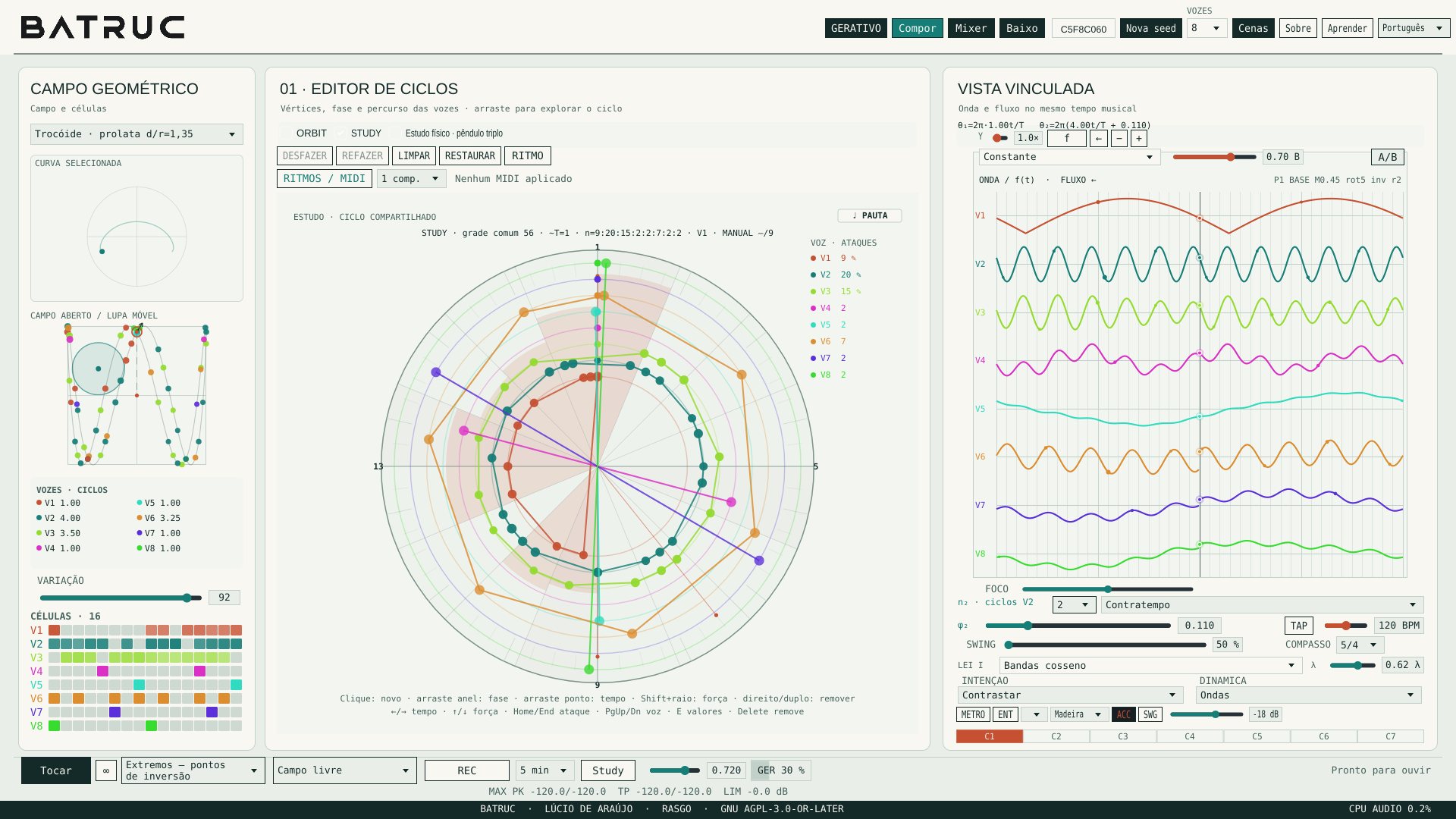
Batruc is a rhythm-composition instrument. Mathematical and physical models — coupled pendulums, billiard, Lissajous figures, Fourier series, rolling curves — write rhythms that you hear, edit, play and take to the score. Generation writes; it does not filter behind your back.
The interface
Download
Choose the package for your system.
Windows
Windows 10 or 11 — installer (.exe) or no install (.zip)
macOS
macOS 10.15 or later, Intel and Apple Silicon
Linux
.deb for Ubuntu, Debian and Mint; AppImage or .tar.gz for other distributions
On first launch, Windows and macOS show a security warning: this is expected, because the app does not carry the two companies' paid signature. The installation guide says where to click.
How it works
Write
Each seed writes figures for kick, snare and hi-hat from a physical model, with phrase form, ruptures and development across seven cycles. Everything stays editable in the Study.
Play
RHYTHM mode plays exactly what is written; GENERATIVE adds the field masks, intensity laws and form, at an adjustable depth.
Ornament
The snare keeps its ornaments on the note — ghost notes, flam, drag, ruff, ricochet, roll, rim, buzz —, and each stem's ORN switch toggles between the plain beat and the full snare.
Notate
A bass staff, in bass clef and in the seed's key, and a drum staff with ornament signs and sticking, both exportable as MusicXML.
Bass and key
The seed chooses a key — twelve tonics and ten modes — and the bass gets a voice of its own: a degree progression, support for part of the kick hits, answers in the gaps and passing notes before each chord change. The percussion can follow the key too.
Rhythms and research
Batruc works with cited sources, not ready-made labels:
- a catalogue of 1,150 drum performances from the Groove MIDI Dataset (Google, CC BY 4.0), with origin, licence and attribution kept in every derived cell; style labels describe performances, they do not define traditions;
- the snare ornaments start from the vocabulary of the Percussive Arts Society's 40 international rudiments, described in Batruc's own words;
- the snare grooves of frevo, maracatu and baião use only what Christiano Galvão's study (Per Musi, 2023) documents;
- the tarol microtiming comes from published measurements of maracatu de baque solto (ISMIR 2020).
Credits
Lúcio de Araújo — concept, composition, interface and code. Licence GNU AGPLv3 or later; JUCE under its AGPLv3 option. Full sources and credits: CREDITS_AND_SOURCES.md.
Status
Version 0.1.5 is the current one; the first release was 0.1.0, in November 2026. Batruc has been built, tested and played on Linux; the Windows and macOS packages are built and tested by continuous integration and have not yet been opened on real machines. The instrument remains in development, open.